How a Virtual SDR Prevents Inbound Leads from Going Unanswered
B2B companies invest increasingly in inbound marketing. The problem starts after the lead arrives. An Inbound Virtual SDR ensures no lead goes unanswered and that the sales team receives opportunities with more context and criteria to build a healthier sales pipeline.
1. The Problem Isn't Just Generating Leads — It's Responding Well
B2B companies invest increasingly in inbound marketing. They create content, run campaigns, optimize landing pages, produce rich materials, improve forms, test ads, and work to attract people with genuine interest. So far, so good. The problem starts after the lead arrives.
In many operations, marketing does its part: generates demand, captures contacts, and creates conversation opportunities. But the initial response doesn't keep the same pace. Some leads get a quick reply. Others wait hours. Some are sent to sales without context. Others sit in the CRM, a spreadsheet, or some notification lost in the daily routine.
This is a silent leak. It doesn't show up as clearly as a campaign with low conversion rate, but it directly affects the return on B2B prospecting investment. After all, every ignored lead represents media spend, content, strategy, and commercial effort that didn't reach the next step.
The core point is simple: an inbound lead has value because it arrives at a moment of intent. They just visited a page, filled out a form, asked a question, downloaded a resource, or demonstrated some kind of interest. If the company takes too long to respond, responds generically, or doesn't respond at all, part of that moment is lost.
This is the context in which an Inbound Virtual SDR starts to make sense. Not as a generic chatbot, nor as another platform for the team to manage, but as an intelligent layer of lead response, qualification, and routing.
The goal is straightforward: ensure no lead goes unanswered and that the sales team receives opportunities with more context and criteria.
2. Why Do Inbound Leads Go Unanswered?
Inbound leads rarely go unanswered due to lack of intention. Most of the time, it happens because the operation wasn't designed to absorb the volume and diversity of contacts that marketing generates.
A lead can arrive through a contact form, another through a product page, another through a media campaign, another through a rich resource download. Each source carries a different level of intent. Yet many companies treat all of them the same way: they enter a queue, receive a standard message, or depend on someone on the team noticing the notification and taking action.
This model works while volume is small. When demand generation grows, the logic starts to break down.
2.1. Volume Grows, But the Process Stays Manual
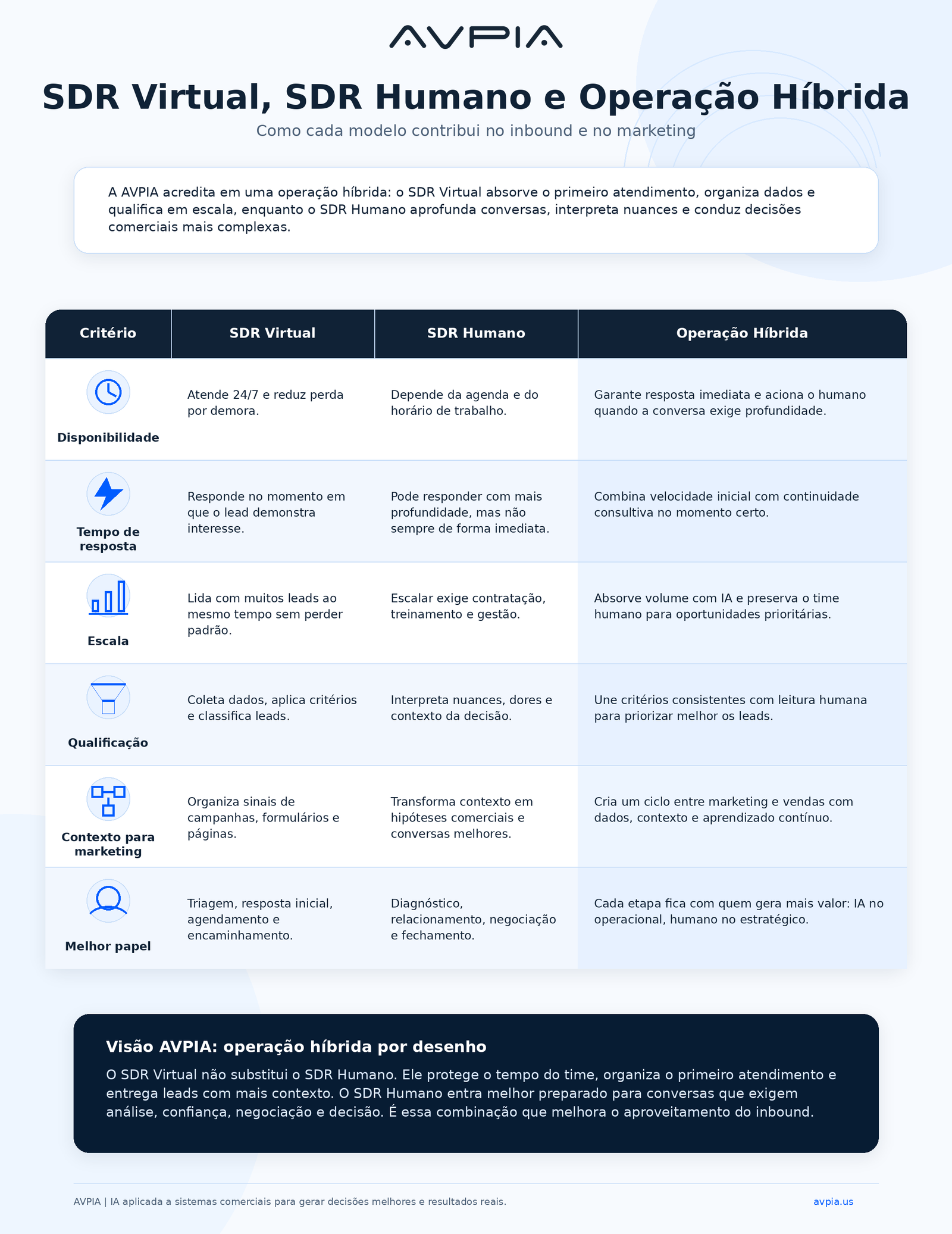
One of the first bottleneck signs appears when the marketing team increases lead volume, but the sales structure stays the same. The human SDR already has tasks, meetings, follow-ups, active prospecting, and internal alignment. The sales rep also has proposals, negotiations, and ongoing clients.
When inbound enters this flow without a clear triage layer, it competes for attention with everything else. In practice, the company starts prioritizing leads that seem more urgent, easier, or more visible. The rest gets pushed back.
The problem is that "later" can be too late.
2.2. Not Every Lead Should Go Directly to Sales
Another common reason is the lack of initial qualification. Many companies send all leads to sales because they don't want to risk missing opportunities. The intention is good, but the effect can be the opposite.
When sales receives many leads without context, the team has to find out from scratch who that person is, what their need is, their buying moment, whether there's budget, whether the company fits the profile, and whether a meeting is worthwhile. This consumes time and creates frustration, especially when many contacts are still in early research stages.
An inbound Virtual SDR helps precisely at this intermediate stage. It engages, collects information, understands context, and separates what needs immediate commercial attention from what should be nurtured or handled differently.
3. What Is an Inbound Virtual SDR?
An Inbound Virtual SDR is an AI-based solution built to respond, qualify, classify, and route leads that arrive at the company. It operates at the beginning of the journey, when the lead has shown interest but still needs to be understood before advancing to a commercial conversation.
AVPIA's Virtual SDR purpose is clear: respond to, qualify, and route leads received by the company, ensuring no lead goes unanswered and that only qualified opportunities advance to the sales team.
This distinction matters because a Virtual SDR should not be confused with a traditional chatbot. A chatbot typically answers questions or runs simple flows. It can be useful, but it often operates with rigid menus, generic responses, and shallow commercial depth. A Virtual SDR needs to go further: understand the context of the interaction, ask relevant questions, log information, and support the decision about next steps.
It's also not just a CRM. CRMs organize information, but they don't typically converse with leads in real time or qualify opportunities on their own. And it's not just automation — automation executes rules. A Virtual SDR needs to apply criteria.
4. Virtual SDR Isn't Just About Speed — It's About Criteria Applied at the Right Moment
When discussing lead response, the conversation often gets reduced to response time. Speed does matter. An inbound lead just demonstrated interest, and that interest tends to be strongest while the interaction is still fresh. But speed without criteria doesn't solve the whole problem.
An immediate but generic response can feel cold. A fast but misaligned message can create a bad experience. A quick but poorly structured automation can route wrong leads to sales or push away good opportunities by misreading context.
Automation doesn't fix a poor structure — it multiplies what already exists. Automating a badly designed process just makes the mistake happen faster.
That's why a Virtual SDR needs to be thought of as a response and decision architecture. It doesn't exist just to say "we received your contact." It exists to understand which lead arrived, in what context, with what need, and what next step makes sense.
4.1. A Practical Example
Imagine two leads filling out a form on the same day.
The first is a marketing coordinator at a B2B company who says they're struggling to respond to all the leads generated by their campaigns. They ask about implementation and want to understand whether the solution can work with their current website.
The second is a student who downloaded content to understand the concept of Virtual SDR.
Both are leads. But they shouldn't receive the same treatment. The first probably deserves more direct qualification and, depending on the answers, an invitation to a demo. The second might be better suited for a nurturing track or educational content.
Without criteria, both enter the same queue. With a well-configured Virtual SDR, each follows the most appropriate path.
5. How a Virtual SDR Qualifies Inbound Leads
Lead qualification needs to answer a practical question: does this contact have real potential to move forward now, does it need nurturing, or is there no fit? A well-designed AVPIA Virtual SDR applies these criteria automatically from the first interaction.
To reach that answer, the Virtual SDR needs to collect information that helps interpret the opportunity: name, company, role, need, budget, timeline, and criteria defined by the business — including whether the lead fits your ICP.
This information shouldn't feel like a cold questionnaire. It needs to appear conversationally, respecting the context of the interaction.
5.1. Qualification Needs to Be Useful for Sales
A common mistake is creating questions that seem good in the form but don't help the sales rep conduct the next conversation. For example, asking "what's your biggest challenge?" can be useful, but the answer needs to be clearly logged. Asking "do you have budget?" might make sense in some operations, but could be too early in others.
The point is that every question should serve a function. If information doesn't help decide the next step, it's probably just creating friction.
A well-designed Virtual SDR reduces that friction by collecting what's necessary, interpreting the response, and routing the lead with context. The sales rep doesn't start the conversation in the dark. They already understand the reason for contact, the initial need, and the fit level.
6. The Difference Between Responding, Qualifying, and Routing
Many operations mix these three stages, but they are different. Responding is replying to the lead and opening a conversation. Qualifying is understanding whether there's fit, need, and timing. Routing is directing the lead to the correct next step.
When these stages aren't separated, the process gets confused. The company responds but doesn't qualify. Qualifies but doesn't route. Routes but doesn't log context. A Virtual SDR needs to connect these stages.
6.1. Initial Response
The initial response reduces the risk of silence. It ensures the lead receives a reply soon after showing interest. This already improves the experience, but it shouldn't stop there.
6.2. Qualification
Qualification transforms an initial interaction into commercial information. This is where the Virtual SDR understands need, profile, urgency, and potential barriers.
6.3. Classification
After qualifying, the system can classify the lead as qualified, partially qualified, or unqualified. This classification helps marketing and sales speak the same language and prevents everything from becoming "a lead for sales."
6.4. Routing
Finally, the lead needs to follow the correct path: meeting, human salesperson, nurturing, specific support, or disqualification. AVPIA SDR Virtual was designed to operate across this full flow — with response, qualification, scheduling, notifications, a simplified pipeline, and a basic dashboard as part of the solution.
7. The Gain for Marketing Teams
For marketing, the Inbound Virtual SDR resolves a pain that often doesn't get enough attention: the efficiency loss after conversion.
A campaign can have a good conversion rate, but if leads aren't properly handled, the final result will be limited. Marketing ends up generating volume, but not necessarily sales funnel progression.
With a Virtual SDR, the team gains visibility into lead quality. It becomes possible to understand which campaigns generate more qualified contacts, which questions come up frequently, which segments have more urgency, and which materials attract leads still far from a decision. Pairing this intelligence with structured automated follow-up sequences ensures those mid-funnel leads don't go cold while they wait for nurturing.
Instead of looking only at volume, marketing starts observing quality, intent, and advancement. This shift helps the team optimize campaigns based on real opportunity, not just form completions.
8. The Gain for Sales Teams
For sales, the main benefit is focus. When the Virtual SDR handles initial triage, the rep receives fewer leads without context and more conversations with some level of qualification. This doesn't mean all routed leads will close. It means commercial time is used more intelligently.
In B2B sales, time is an expensive resource. A poorly qualified meeting can consume schedule, preparation, and team energy. When this repeats frequently, productivity drops and the perception of marketing leads deteriorates.
The Virtual SDR helps reduce this noise. It doesn't replace the human conversation, but better prepares the ground for it to happen. AI shouldn't eliminate human judgment — it should organize context so that judgment is applied where it generates the most value.
9. Where Traditional Solutions Often Fall Short
Many tools promise to solve lead response, but end up addressing only part of the problem. Some respond quickly but don't qualify well. Others create automated flows but require excessive configuration and maintenance. Some work as chatbots but lack sufficient commercial logic to differentiate a lead ready for a meeting from someone just curious.
The most common gap is the absence of criteria. When the solution doesn't understand what makes a lead relevant to that specific company, it just moves contacts from one point to another. This may organize the process, but it doesn't necessarily improve the decision.
Data isn't decisions — data is signals. For those signals to guide action, they need to be interpreted within context and evaluated by clear criteria. A form submission is a signal. The page visited is context. The company profile is context. Without criteria, the process stays superficial.
10. How to Implement an Inbound Virtual SDR with Maturity
Implementation shouldn't start with the tool. It should start with commercial logic. Before going live with a Virtual SDR, the company needs to define what it considers a qualified lead, what information is needed for first-pass triage, what questions should be asked, and what paths a lead can follow.
It's also important to map entry points. Do leads arrive through the website? Landing pages? Campaigns? WhatsApp? Each source may require a different approach.
After that come the operational definitions: who receives qualified leads, how scheduling will work, what notifications will be triggered, how conversation history will be logged, and what metrics will be tracked.
10.1. Metrics That Help Evaluate Results
Some metrics are especially useful for tracking progress:
✅ Average first response time
✅ Percentage of leads responded to
✅ Percentage of leads qualified
✅ Scheduling rate
✅ Meeting attendance rate
✅ Disqualification reasons
✅ Lead sources with highest fit
✅ Time saved by the sales team
These metrics help understand whether the Virtual SDR is just responding, or whether it's genuinely improving the flow between marketing and sales. Comparing them against broader SDR team KPIs helps leadership see whether the automated layer is producing pipeline quality consistent with human benchmarks.
11. The Future of Inbound Is About Context, Not Just Volume
For a long time, inbound was treated primarily as an attraction and lead qualification machine. Attract visitors, convert leads, nurture contacts, and generate opportunities. That logic is still valid, but today it needs an additional layer.
The number of signals has increased. A lead may interact with ads, pages, content, emails, social media, and messages before speaking with a person. Each interaction helps understand intent, but also increases process complexity.
The future of inbound won't be defined by who generates the most inbound leads. It will be defined by who responds better, interprets better, and routes better. See how this connects to the marketing-to-sales handoff problem more broadly.
A well-implemented Virtual SDR helps precisely with that transition. It transforms the first response into a more structured stage without losing conversational flow. The lead is received, understood, and directed with more consistency.
For companies that invest in marketing, this changes the funnel logic. The goal shifts from simply capturing contacts to better leveraging every intent signal that arrives.
12. What AVPIA SDR Virtual Solves in Practice
AVPIA SDR Virtual was developed for companies that receive B2B prospecting leads but can't respond to all of them with the speed, context, and consistency they need. Combining it with AVPIA CRM ensures every qualified conversation is tracked and visible to the full commercial team. For teams that also want to understand which accounts have the highest strategic potential before any conversation, ABM Intelligence provides that organizational insight layer.
The proposition is simple: act as a Virtual SDR specialized in inbound, capable of responding, qualifying, classifying, scheduling, and routing leads to the right team. Not as a generic chatbot or a complex platform, but as a Virtual SDR that works continuously to give every lead a real chance of becoming an opportunity.
For marketing teams, this means reducing the waste of generated leads. For sales, it means receiving opportunities with more context. For the company, it means creating a more reliable process between the lead's interest and the commercial conversation.
If your company generates leads but still relies on manual responses, queues, loose notifications, or improvised triage, the problem may not be in demand generation. It may be in what happens after the lead arrives.

No lead left unanswered
Discover AVPIA SDR Virtual and see how to build a smarter initial response process for your leads.
Explore AVPIA SDR Virtual